Project work at Elisabeth High School Halle
The German Foundation for the Preservation of Historical Monuments has included the project work of the Elisabeth-Gymnasium (ELG) for the 2024–25 and 2025–26 school years in its school program. The foundation’s website states the following about the ELG project:
„For several years now, the Sinti Mausoleum has been an important place of learning for 9th and 10th grade students at the Elisabeth Gymnasium in Halle. The school is part of a larger network committed to preserving this extraordinary architectural monument and has repeatedly drawn attention to its significance on Open Monument Day. […]“
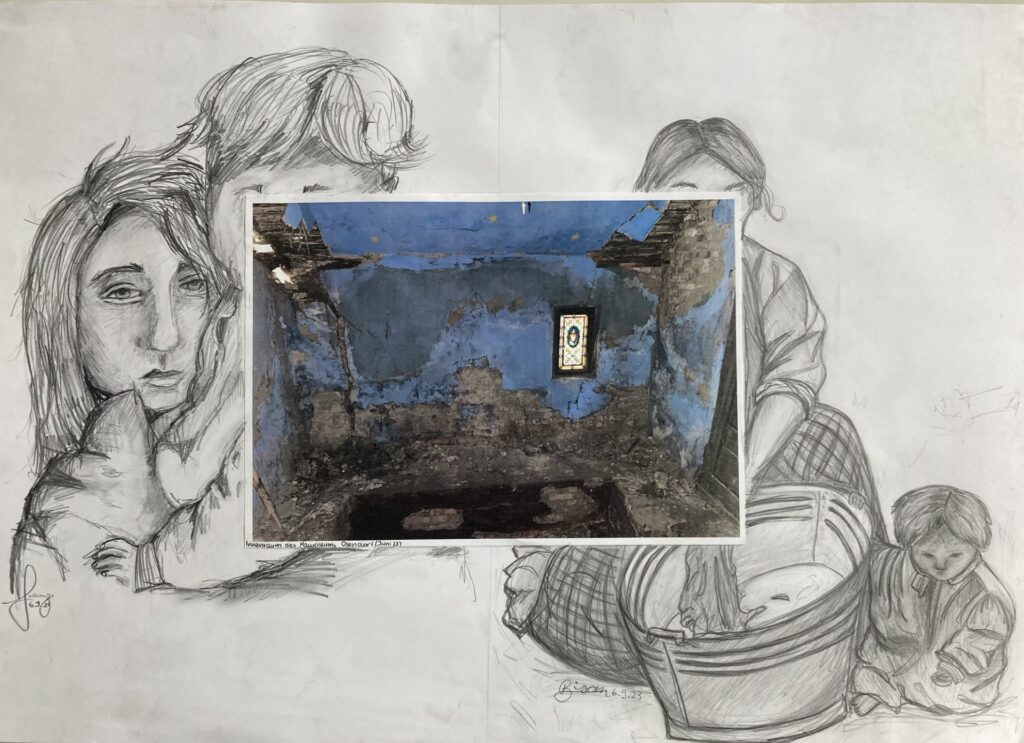
The students record their findings in texts, drawings, and digital formats and present them publicly in order to raise awareness of the Sinti Mausoleum as a place of remembrance and learning among the city’s population.
website Denkmal aktiv (german)
The images and texts on this website were created during the project work at the ELG and presented to the public at the annual Open Monument Day.
Remembrance culture work at Elisabeth High School
The project at Elisabeth Gymnasium is part of a comprehensive remembrance culture initiative that focuses on Elisabeth’s commitment to helping others, the inhumanity of National Socialism, and German-German experiences that influence the realities of life today.
Remembrance work at ELG encourages critical thinking and independent, rational judgment in the face of burgeoning fundamentalist, even right-wing extremist populism in the school’s regional neighborhood.
In a confusing, crisis-ridden time, the remembrance culture work at the ELG makes a contribution that opens up the future for the formation of personal identity and social cohesion within the framework of the free democratic basic order.
See also: www.ess-elisabeth.de/bildung/schule-im-dialog/durch-erinnern-und-vergegenwartigen/ (german)
Design for a stained glass window in the renovated mausoleum
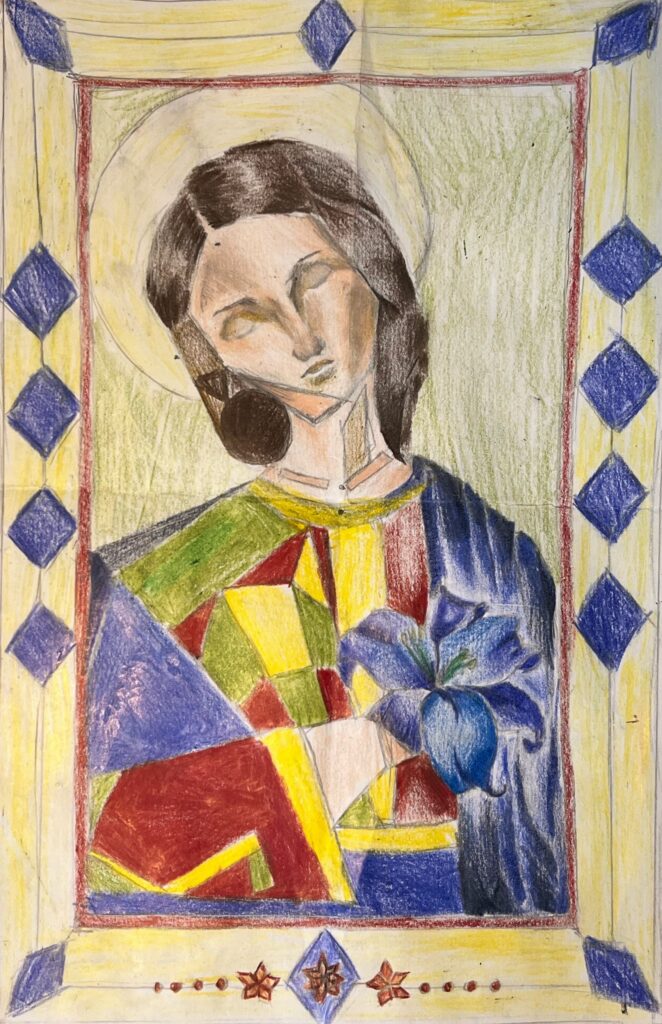
The student Anna Rescheleit notes about her design:
„Josef Weinlich built the mausoleum. After his death, his daughter and granddaughter, Grete and Anna Weinlich, had to fight for their lives in Auschwitz. They were deported because they were Sinti and Roma. Grete did not survive the concentration camp, but her daughter Anna did because she held fast to her faith, the veneration of Mary. That is why Mary is in the spotlight of the window. Modern and older art styles are combined in her. Lifelike contours and geometric figures come together in Mary. The contrast is intended to connect the past and the future. It is intended to convey a warning from history. Mary holds a blue lily in her hand not only because she is often depicted with one, but also because blue lilies are used as grave decorations. The image is framed by a specific arrangement of dragon squares. This pattern can already be found in a window in the mausoleum that is still intact. This brings both windows into harmony. Each individual star in the lower frame of the picture symbolizes one of the deceased people who have been buried in the mausoleum over time.„